Laura S. Marshall
Spotify Wrapped On-Off Project
2024 / iPhone App Feature

Roles:
I was the self-directed lead UX/UI designer and researcher for this project. I conducted all user research, wireframing, prototyping, visual design, and testing for this project. I am not affiliated with Spotify; I conducted this project for research and education purposes only.
Date:
February 2024 (3 weeks)
Tools:
Figma, Google Workspace
Overview
The problem: When Spotify Wrapped debuted in 2016, it offered listeners a way to view and share a snapshot of their listening habits for the previous year; each year, Wrapped has evolved, and it is now an eagerly awaited end-of-year moment for a large number of Spotify’s 600-million-plus listeners, many of whom share their Wrapped results on various social media platforms.
However, some Spotify listeners have learned that their Wrapped results are not always accurate: People who listen to music on car rides with their kids often find their results skewed in favor of children’s songs; artists and creatives who use Spotify for inspiration and background music report that their favorite artists and songs are not reflected in their year-end lists; people with sleep disorders who play ocean waves or nature sounds all night end up with literal snooze-fests in their Wrapped recaps.
Many of these users are less likely to share their results on social media because they feel these results don’t reflect their actual tastes in music.
Further, some users are so invested in their end-of-year Spotify Wrapped results that they alter their usage of the streaming app if they have to listen to songs or albums outside of their “typical” listening habits. These users often even use other apps, drawing them away from Spotify and decreasing their time spent with the app.
The Wrapped On-Off app setting empowers Spotify listeners to opt out of Wrapped statistics for certain songs, albums, and playlists.
User Research
Summary: To understand the problem, I conducted user interviews, constructed personas, and developed user journeys to guide my design. My research revealed that some listeners were very averse to “messing up” their Spotify Wrapped results by playing tracks outside their typical listening habits, and that they often would go so far as to listen to these “atypical” tracks on other platforms such as YouTube or Amazon Music. This was frustrating for them, as they had to toggle between apps and sometimes even pay for additional services.
- Pain Point: Image
People want their Spotify Wrapped results to align with their self-image. When users have to play certain songs repeatedly for their children, for example, they often end up with Wrapped results that don’t align. - Pain Point: Complexity
Adjusting settings within an app can be cumbersome, especially if you have to switch often between “On” and “Off.” Users want to be able to switch on demand quickly and easily. - Pain Point: Variety
Users play a range of tracks for a range of reasons in addition to enjoying favorite songs: inducing sleep, entertaining kids, learning something, building a mood for art creation, and much more. Spotify Wrapped currently doesn’t account for these varying reasons.

User persona: During the empathize phase of the process, two user personas arose. These target personas, based on my research, informed my design choices and made my product more useful.
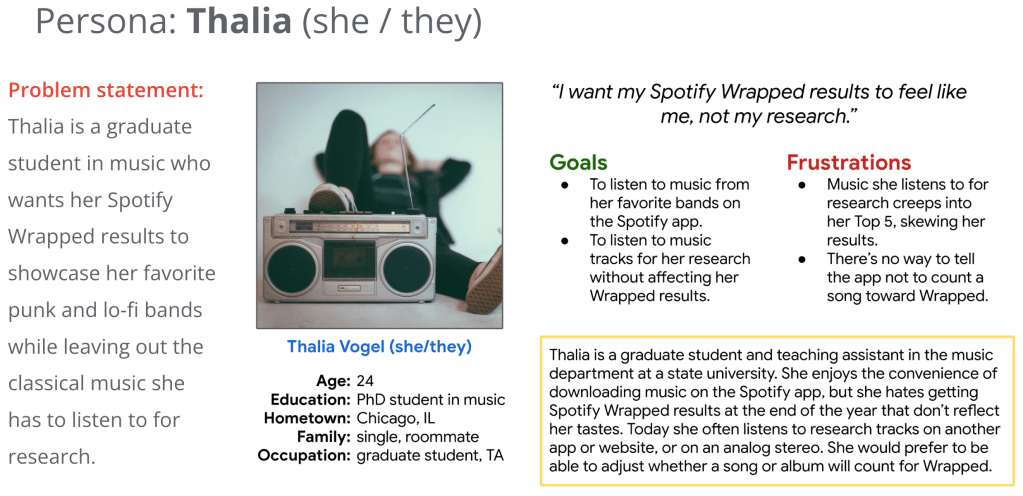
Thalia, 24, is a graduate student in music who wants her Spotify Wrapped results to showcase her favorite punk and lo-fi bands while leaving out the classical music she has to listen to for research.
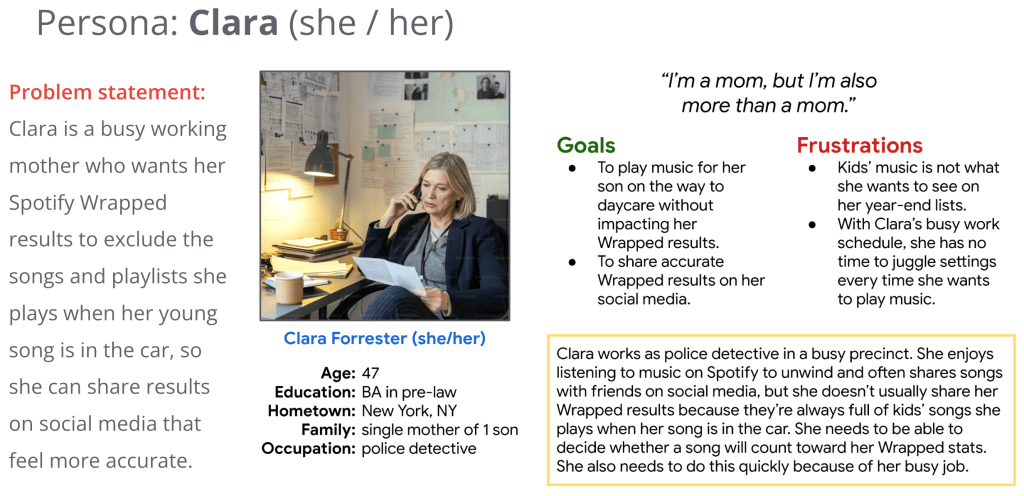
Clara, 24, is a busy working mother who wants her Spotify Wrapped results to exclude the songs and playlists she plays when her young son is in the car, so she can share results on social media that feel more accurate.
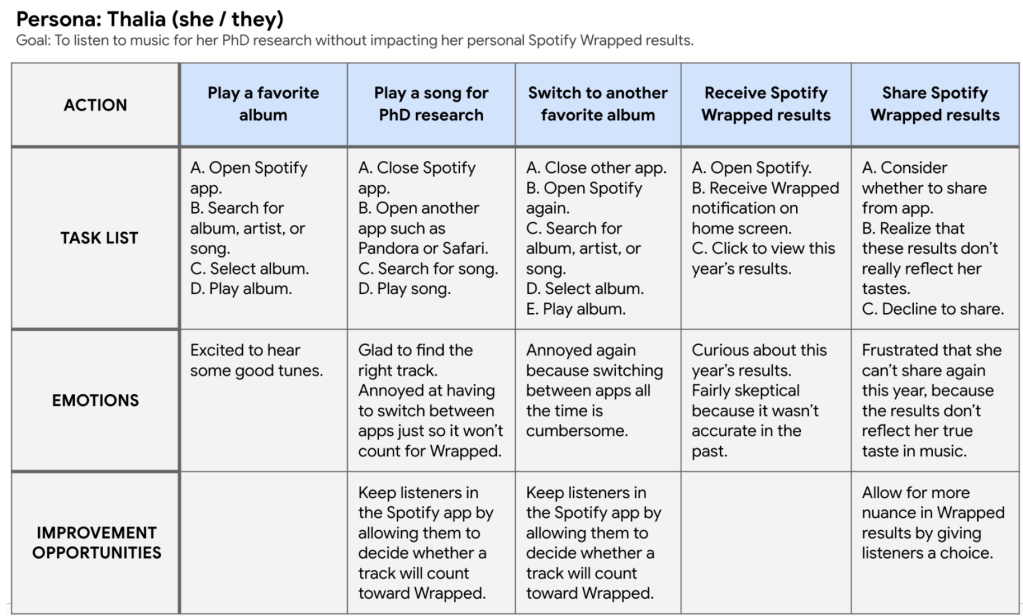
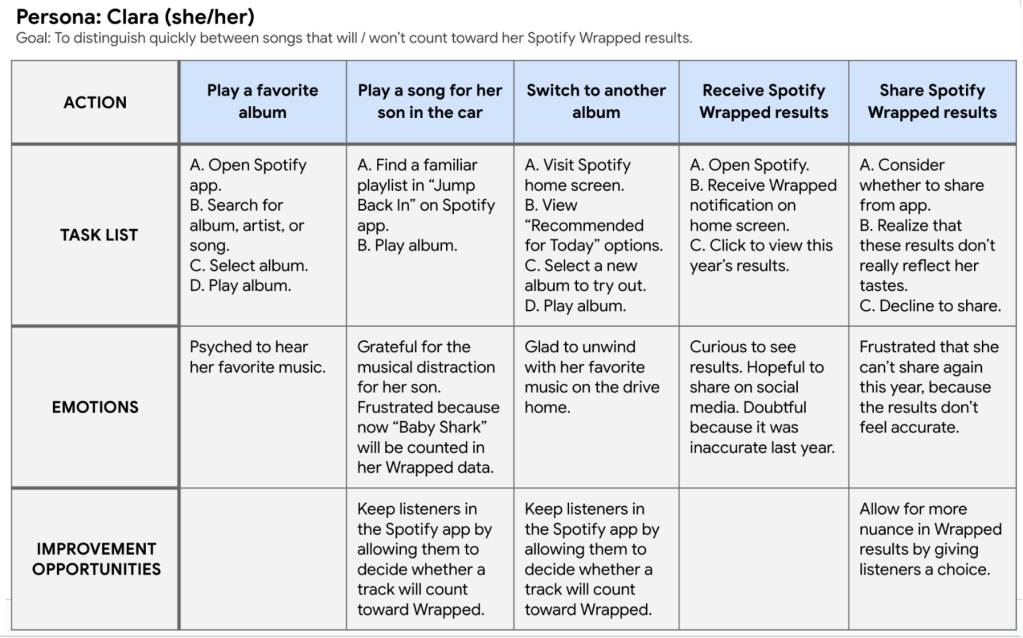
Mapping Thalia’s and Clara’s user journeys helped me to see where current solutions left some users out and where we could develop improvements. I could see how important it would be to create a way for users such as Thalia to opt out of Wrapped for select songs or albums.
Some must-have features emerged during this phase:
- Quick and easy toggle-based feature
- Ability to switch between Wrapped “on” or “off” for individual songs as well as albums and playlists
- A notification pop-up upon introduction of the feature to explain how it works
Ideation and Design
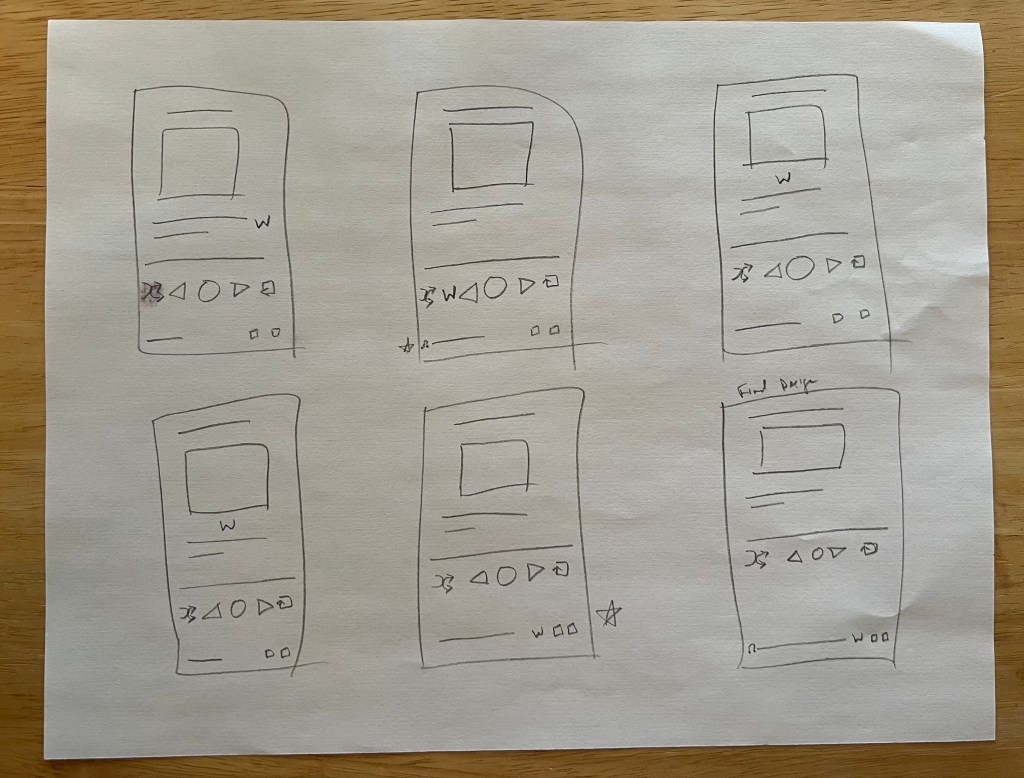
Paper wireframes: Working with an existing app, I knew I needed to design a feature that could be inserted seamlessly into the existing design without creating too much of a disruption for users. I worked to find a place on the existing song screen where users could quickly and easily toggle between Wrapped “on” and “off.” I chose to place it on the bottom row so it would be accessible but unobtrusive.
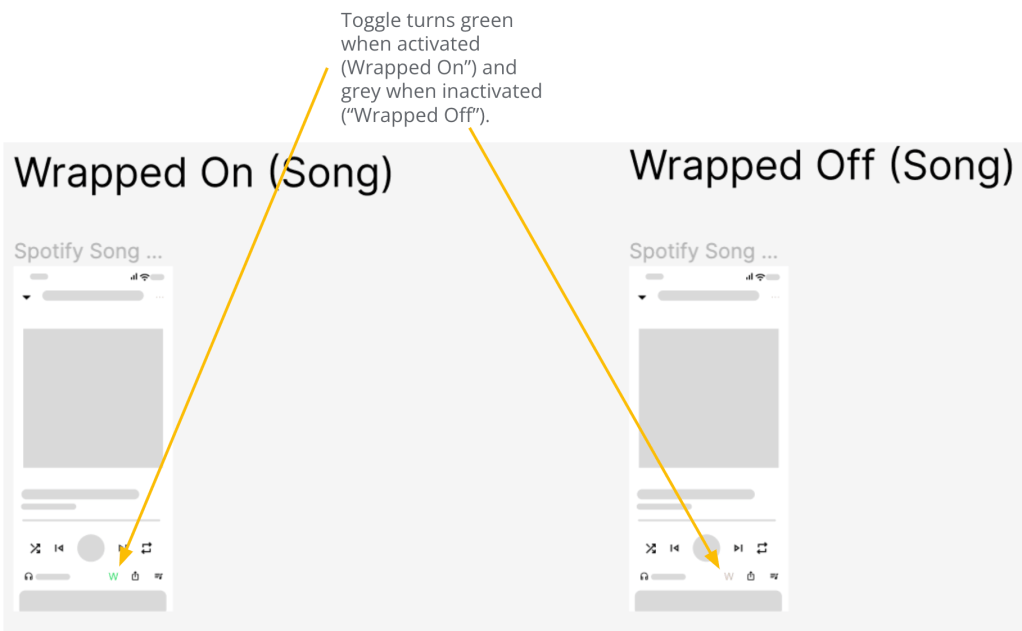
Digital wireframes: This is a simple digital wireframe for the new Spotify feature, based on user research that showed users want to be able to toggle between “Wrapped On” and “Wrapped Off” quickly and easily.
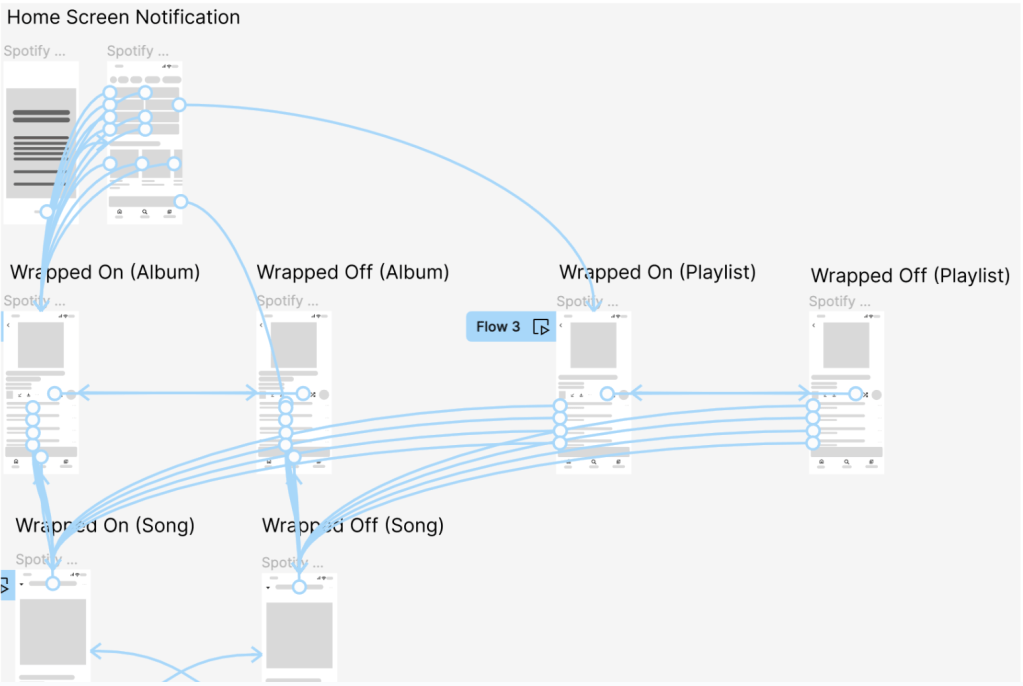
Low-fidelity prototype: My low-fidelity prototype followed the user from receiving the notification message on their Spotify home screen to toggling between “on” and “off” for a song, an album, and a playlist. View the lo-fi prototype here.
Usability Study
Once the lo-fi prototype was functional, we needed to find out whether it was easy enough to toggle between “on” and “off” options. We hoped to understand the specific challenges users may encounter in the Wrapped opt-out process, so that we could fix those issues before launch.
Research questions:
- How long does it take to opt out of Wrapped for a song?
- How long does it take to opt out of Wrapped for an album or a playlist?
- What steps do users take to opt out of Wrapped?
- What steps do users take to opt back in when they’re done with their “atypical” song, album, playlist, or session?
- What frustrations do users encounter in the Wrapped opt-out process?
Methodology and participants: This was an unmoderated usability study, held remotely; each of the five participants went through the test on their own at home. Each session lasted 60 minutes and included an introduction, a list of tasks, and a brief questionnaire.
Participants were all Albany, NY-area residents who are adults and who have used Spotify regularly for music, podcasts, and more for at least two years. They were chosen from a screening survey given to members of a local music Facebook group. As an incentive, we gave each a $20 gift card to a local eatery. The participants were two females, one male, and two nonbinary individuals, all between the ages of 20 and 75.
Observing users showed that the Wrapped opt-out feature was easy to use and intuitive for the users, but that it could use the following fixes:

Mockups and Prototyping
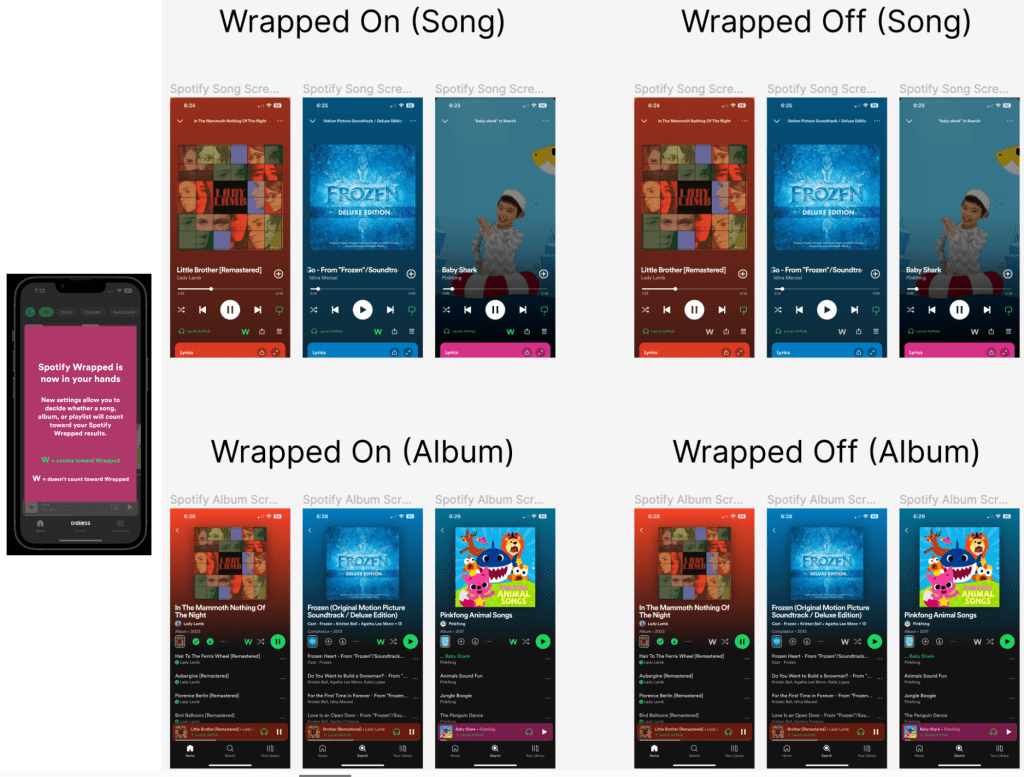
High-fidelity prototype: My high-fidelity prototype followed the user from receiving the notification message on their Spotify home screen to toggling between “on” and “off” for a song, an album, and a playlist. View the high-fidelity prototype here.
Responding to usability study results
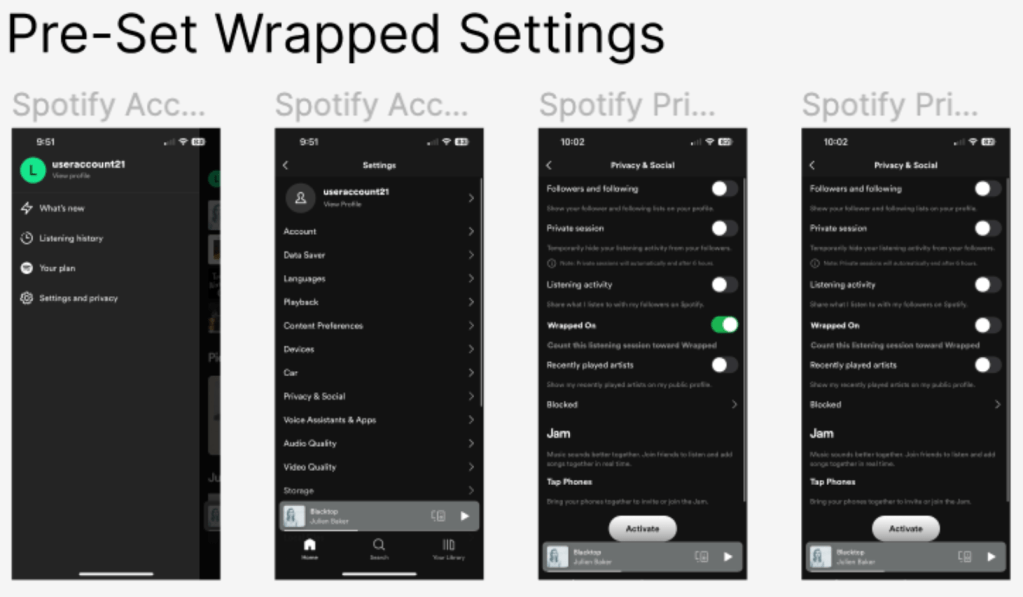
We had found that listeners wanted a way to pre-set Wrapped settings for an entire listening session, so that they could “set and forget” for car rides with their kids, for example. In the high-fidelity prototype, we added an option to pre-set Wrapped settings for a session in the user’s account settings:
Accessibility Considerations
- Spotify has established accessibility standards including readability and text resizing. This new feature is consistent with sizing and can be resized along with the other features as needed by the user.
- For easier viewing, I always choose high-contrast colours, and in this case the standard Spotify colours (white, black, green) meet accessibility requirements as outlines on accessible-colors.com.
- For ease of use, I kept the button for this new feature next to the shuffle and play buttons on each screen. Users are accustomed to finding these buttons in specific places on the song, album, and playlist screens and will be able to find them readily from screen to screen.
Takeaways
Impact: The Spotify Wrapped On-Off app feature enables users to opt out of Wrapped statistics for certain songs, albums, and playlists, so their Wrapped results would feel more accurate.
One research study participant, a PhD student in music, commented: “I want my Wrapped results to feel like ME, not my research.”
What I learned: This project showed me that sometimes meeting the needs of the user (changing settings) can also meet the needs of the business. In this case, adding the ability to toggle Wrapped “on” or “off” was convenient for users, as they could use Spotify more for their music instead of switching to other apps.
I also learned about maintaining consistency in design and the importance of seamless integration.
Next steps
Thoughts
This project was based on empathy for people who inhabit multiple identities in a day: parents, students, workers, and so on. They might love each and every hat they wear, but they don’t want to be seen ONLY as a mom or a student or an employee. They want to share Spotify Wrapped results at the end of the year that reflect how they see themselves.
I wanted to give these multifaceted people an easy and convenient in-app solution that would allow them to count certain songs, albums, playlists, or entire listening sessions out of their Wrapped results, so their year-end results reflect their actual tastes in music.
One of the most popular and fun features of Spotify Wrapped is that it’s designed to be shared widely on social media. When Wrapped results don’t align with a user’s self-image, the user is less likely to share their results. This can make them feel left out when all their friends are sharing and commenting on each other’s outcomes. It can also make them less excited to see their Wrapped results at the end of the year, and can even cause them to alter their listening habits to use different apps for certain sessions, instead of sticking with Spotify, which is less convenient for the user.
Opting out of Wrapped for select songs or sessions allows users to close out the year with accurate Wrapped results while still using Spotify for all their listening needs.
 Laura S. Marshall